
Commercial Grounds Management Across the Carolinas
Landscaping, mulching, irrigation, drainage, storm cleanup, and property maintenance for commercial sites. Crews dispatched from four Carolina branches.
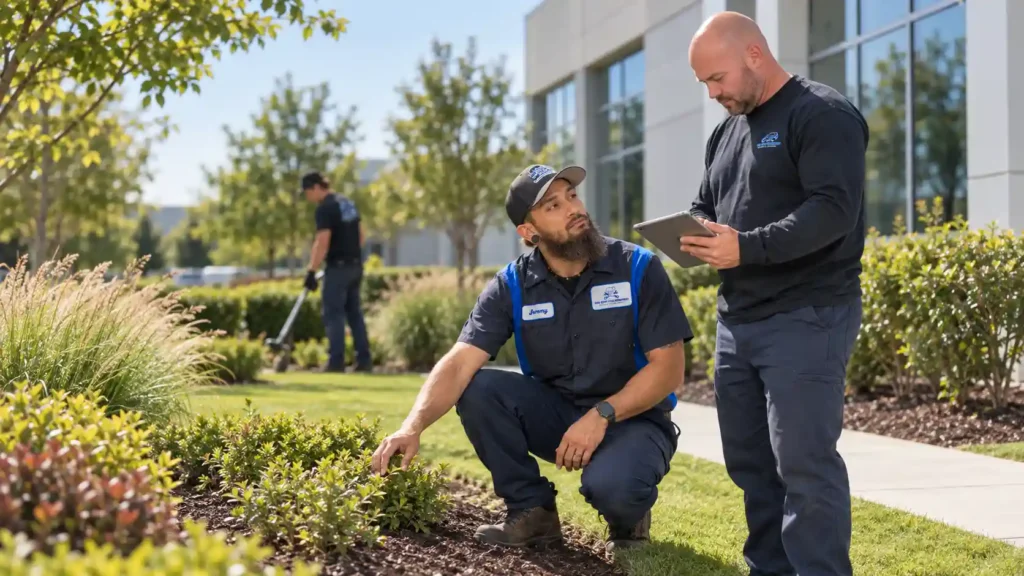
Pro-Serv Facility Solutions provides commercial grounds management, landscaping, mulching, irrigation, drainage, storm cleanup, seasonal cleanup, land clearing, and ongoing commercial property maintenance for businesses across North Carolina and South Carolina. Four branches cover New Bern, Raleigh, Wilmington, and Charlotte. Pro-Serv is a CFESA certified company serving offices, retail, restaurants, and commercial facilities, with technicians on call 24 hours a day.

What grounds management services does Pro-Serv provide?
Pro-Serv Facility Solutions handles commercial grounds maintenance and landscaping, mulching and bed work, irrigation, drainage, storm cleanup, seasonal cleanup, land clearing, and general commercial property maintenance. Work covers offices, retail centers, restaurants, schools, healthcare buildings, warehouses, and multi-site portfolios across both Carolinas.
Nobody walks into a building admiring the landscaping. They notice it only when it has gone wrong: mulch beds gone grey and thin, the parking lot island full of weeds, the corner that floods every time it rains hard. Grounds work is judged on how little attention it draws.
What is the difference between grounds maintenance and landscaping?
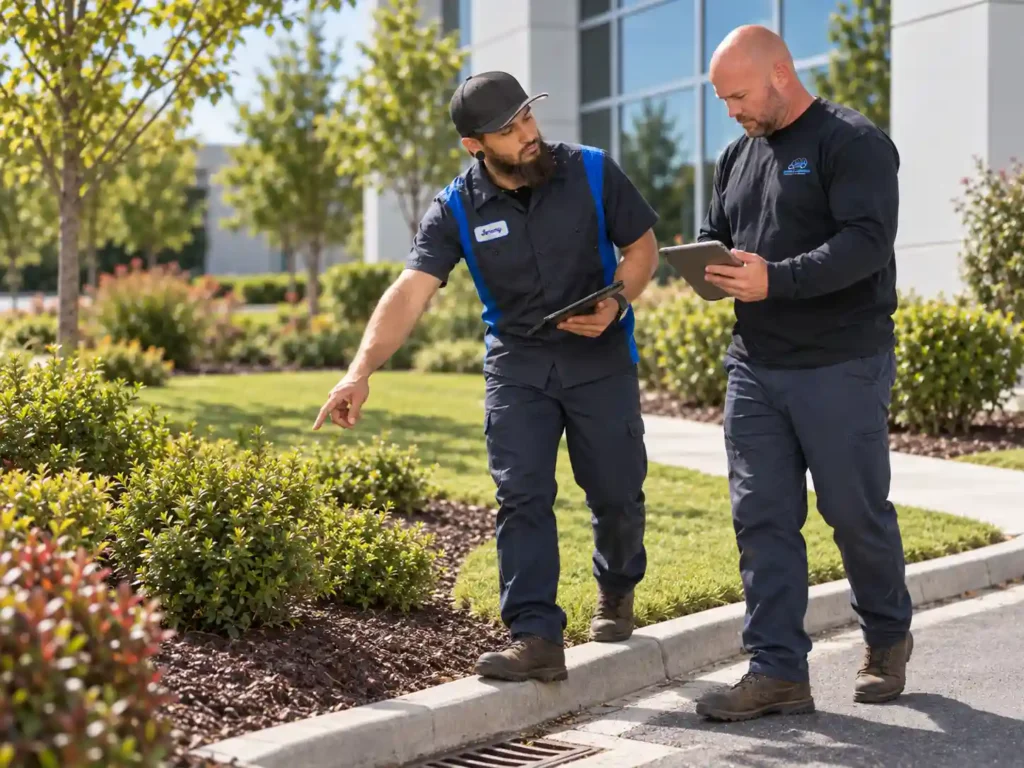
Landscaping is the work that changes a property: design, planting, hardscape, installation. Grounds maintenance is the recurring work that keeps it that way once it exists. Most commercial properties need far more of the second than the first, which is why grounds work is usually sold as a contract rather than a project.
The two words get used interchangeably and they are not the same purchase.
Landscaping is a project. It has a start, an end, and a result you can photograph. Grounds maintenance is a service. It has a schedule, a scope, and a standard, and the result is that nothing changes.
Most commercial sites were landscaped once, years ago, by whoever built them. What they need now is the second thing. When a property looks tired, it is rarely because the design was wrong. It is because twelve months of ordinary upkeep did not happen.
The distinction matters when you compare bids, because a maintenance agreement and an installation contract are different documents with different obligations. North Carolina licenses landscape contractors through the NC Landscape Contractors’ Licensing Board.
Pro-Serv sells the recurring side.
How does a commercial grounds contract actually work?
A commercial grounds agreement sets a visit frequency, a defined scope of what each visit includes, and a season-by-season schedule for the work that happens only at certain times of year. Anything outside that scope is quoted separately before it happens. Pro-Serv builds the schedule around how the property operates.
Most grounds problems are contract problems before they are landscaping problems. Three questions settle it: how often does a crew come, what exactly do they do while they are there, and what happens when something falls outside that.
Professional. Reliable. Hard Working. Team Driven. Results Matter.
Every Pro-Serv crew works to the same standard, whether it is a single property on a monthly schedule or a portfolio of sites across two states. CFESA certified. On call 24 hours a day.
What does a year of grounds management look like in the Carolinas?
North and South Carolina sit in the turf transition zone, where neither warm-season nor cool-season grass is fully at home. That makes the maintenance calendar different from a national template: timing on pre-emergent, aeration, overseeding, and pruning windows all shift, and getting them wrong costs a full season.
The Carolinas are a genuinely awkward place to grow turf. The transition zone is too hot for cool-season grass and too cold for warm-season grass, so most commercial properties run some compromise of both and every task has a narrow window. NC State Extension publishes the regional guidance in TurfFiles, and it does not match the calendar a national franchise runs from another climate.
Timing matters more than effort. Pre-emergent applied three weeks late does nothing. Aeration in the wrong month stresses turf instead of helping it. Pruning a spring-flowering shrub in winter removes the flowers.
A Carolinas commercial grounds year
This is the general shape of a Carolinas commercial year. The specific schedule for a property comes out of a site walk, not a template.
What happens when a storm comes through?
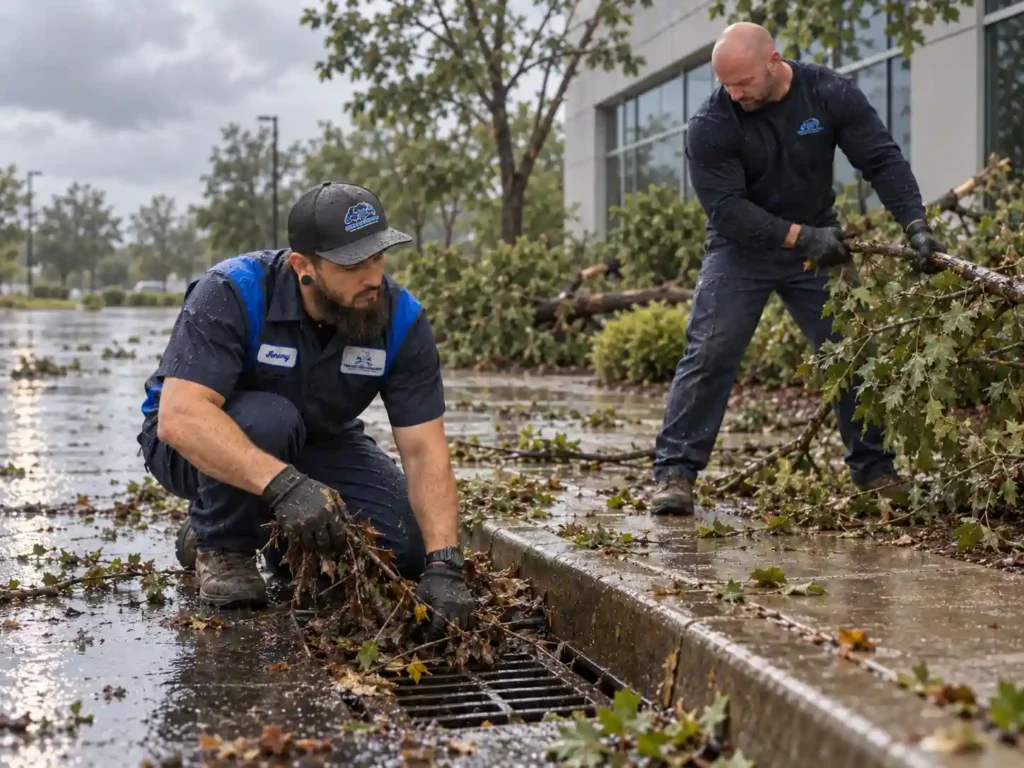
Pro-Serv provides commercial storm cleanup across North Carolina and South Carolina, including debris and downed limb removal, clearing blocked access and parking, and drainage work after flooding. Branches in New Bern and Wilmington sit in the state’s most storm-exposed markets, and technicians are on call 24 hours a day.
Coastal Carolina businesses do not treat storms as hypothetical. New Bern and Wilmington both sit where the National Weather Service tracks every season, and a property that cannot open the morning after is losing a day that a competitor two miles inland is not.
The work after a storm is rarely complicated. It is limbs across a parking lot, debris against a door, a blocked drain, a sign nobody can see. What matters is whether anyone shows up the day it happens rather than the following week when the schedule allows.
That is the part most grounds contractors are not structured for. A mowing route is a fixed weekly loop, and an emergency does not fit into it.
Pro-Serv already runs 24 hour dispatch for equipment failures. The same number and the same after-hours structure covers grounds. That is not a new capability built for this division, it is the one the company has run for years pointed at the outside of the building.
Drainage is the follow-up nobody schedules. If a lot held water for two days, that is worth looking at before the next storm rather than after it.
What does a grounds management program include?
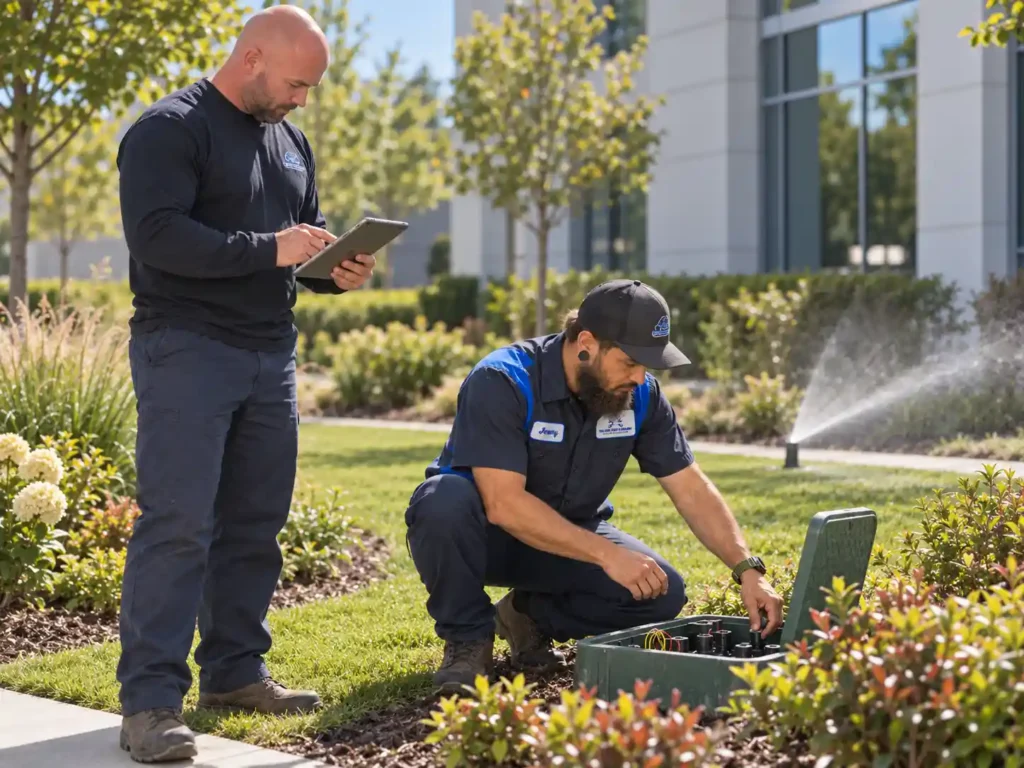
A Pro-Serv grounds program covers scheduled maintenance visits at a set frequency, seasonal work timed to the Carolinas calendar, irrigation startup and shutdown, mulch and bed refreshes, and a record of what was done on each visit. Programs can cover grounds alone or sit inside a full facility preventative maintenance program.
A program typically includes:
- Recurring maintenance visits at an agreed frequency
- Bed maintenance, weeding, pruning, and mulch refreshes on a seasonal cycle
- Irrigation startup, shutdown, and zone checks through the year
- Seasonal cleanup, including leaf season
- Drainage and site checks after heavy weather
- A record of each visit and anything flagged for attention
The record is what pays off over a few years. It turns “the beds always look bad by August” into something specific: which beds, what was done, and when. That is what a property manager needs to defend a budget, or to make the case that a drainage fix costs less than clearing the same flooded corner three times a year.
Grounds can also run inside a single facility program alongside commercial pressure washing, HVAC, refrigeration, and hood systems, on one schedule and one account.
What does commercial grounds management cost?
Commercial grounds cost depends on the size of the property, how much of it is turf versus beds versus hard surface, visit frequency, irrigation zone count, and how much seasonal work is in scope. Pro-Serv quotes after walking the site, because acreage alone does not predict what a property takes.
Cost takes three shapes.
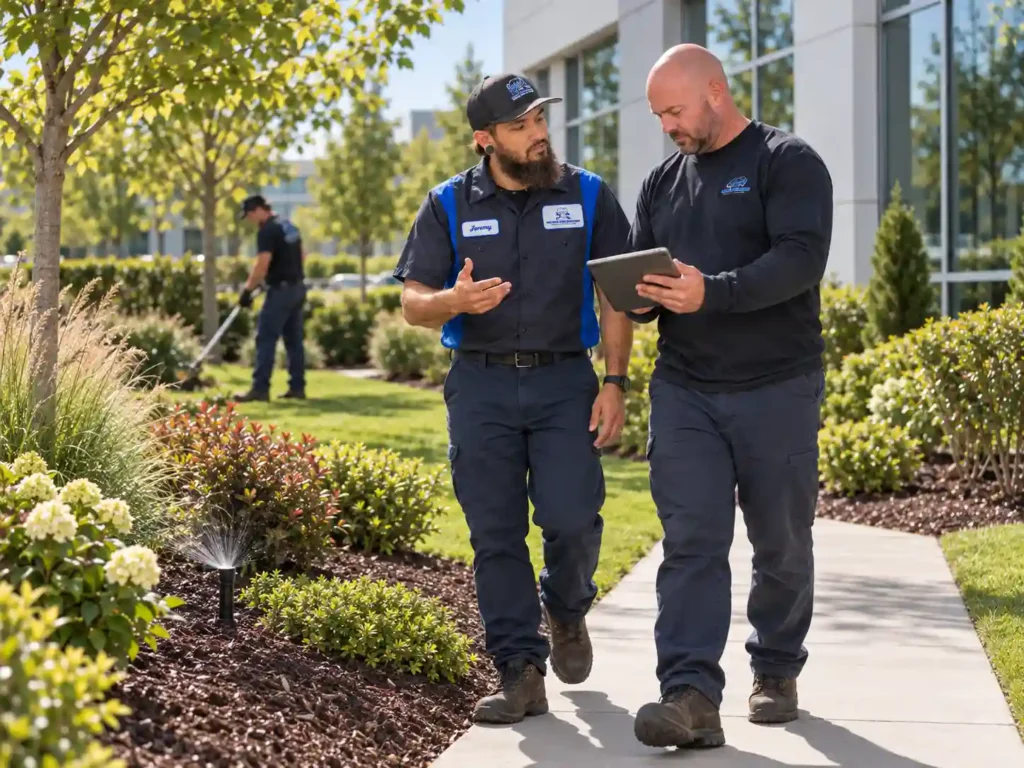
A recurring maintenance agreement is a flat monthly or annual figure, set by property size, visit frequency, and scope. This is how most commercial grounds work is bought.
Seasonal and one-time work is priced per job. Mulch refreshes, land clearing, drainage, and major cleanups sit here.
Storm response is priced by the work involved, because nobody can scope a storm in advance.
We do not quote grounds work off a map. Two properties with identical acreage can be very different jobs: one is open turf a crew mows in an hour, the other is a dozen small beds, tight islands, and slopes. A number given before anyone has walked the site is a number that changes.
Commercial Grounds Service Options
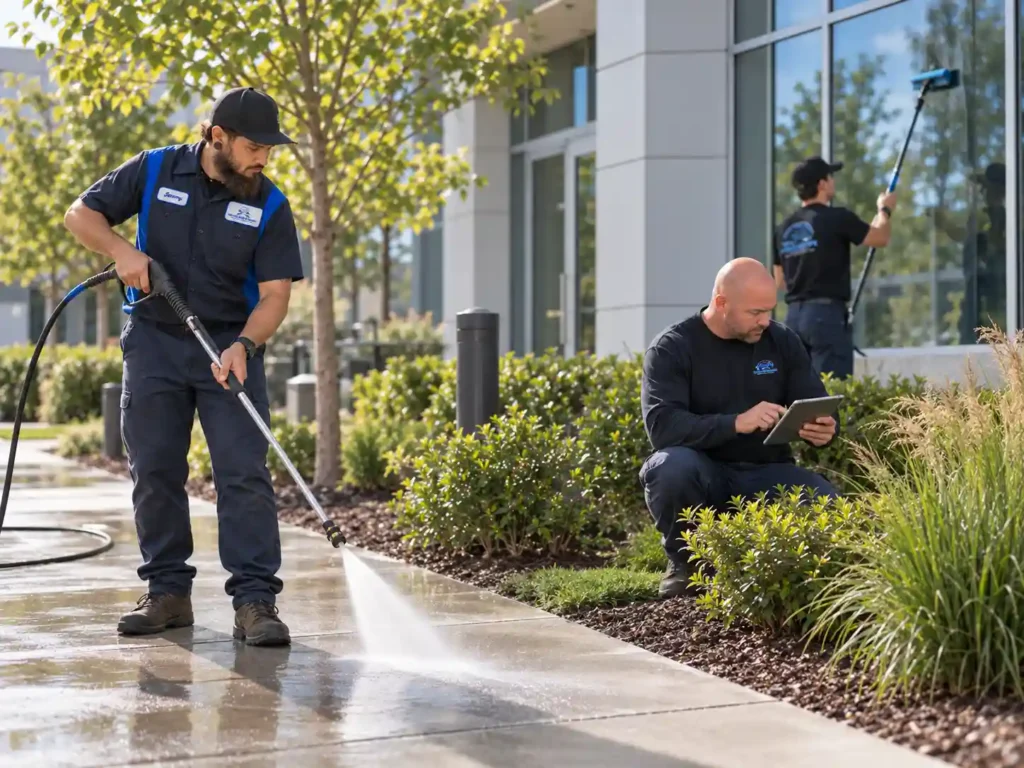
Why work with one company for grounds, pressure washing, and the rest of the building?
Pro-Serv covers commercial grounds management alongside pressure washing, HVAC and heating, plumbing, hood and exhaust cleaning, kitchen equipment repair, equipment sales and installation, and refrigeration. One account, one service number, four Carolina branches.
A landscaping company can only ever solve the landscaping. That is the shape of the business, not a criticism. But a property is not divided the way a vendor list is.
The clearest example is the one right at the edge of this division. Grounds work covers everything green, plus drainage and land. Pressure washing covers the hard surfaces: the sidewalks, the dumpster pad, the drive-thru lane, the parking lot. Those two jobs happen on the same property, usually in the same week, and with two vendors they are two schedules, two invoices, and two companies each certain the mess belongs to the other.
With one company they are one visit.
That pattern repeats going inward. The drain outside and the plumbing inside are the same water. The dumpster pad, the grease, and the hood system are the same problem at three points. A facilities team with one number to call spends its time on the building instead of on coordinating the people who service it.
For a business running multiple sites, that compounds. One account and one standard across every location beats a different landscaper in every market, each with its own rates and its own opinion about what the contract covered.
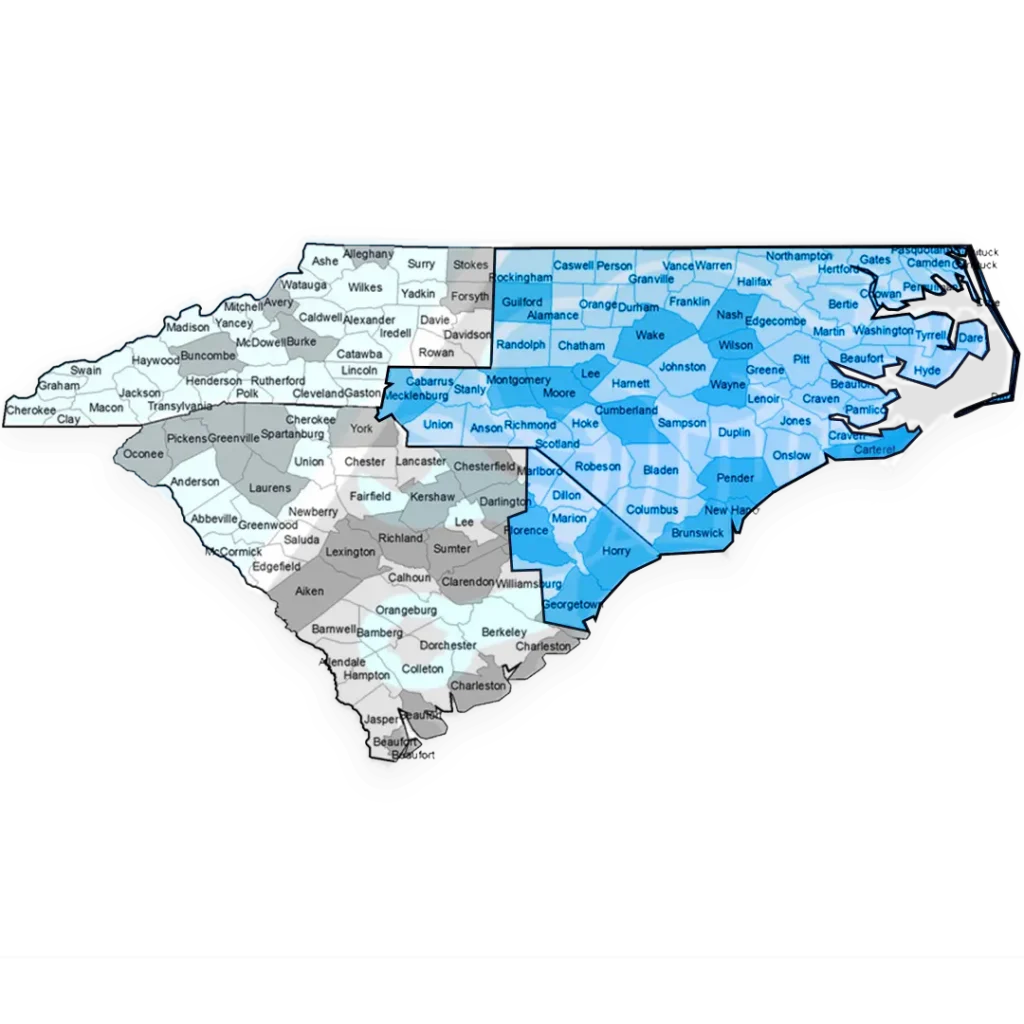
North Carolina & South Carolina Service Areas
Where does Pro-Serv provide commercial grounds management?
Pro-Serv provides commercial grounds management across North Carolina and South Carolina from branches in New Bern, Raleigh, Wilmington, and Charlotte. Coverage extends to Greenville, Kinston, Morehead City, Myrtle Beach, and the surrounding markets. Multi-location businesses can run every site through a single account.
Coverage runs across both Carolinas rather than one metro. That matters more for grounds than for most trades, because grounds work is the service a multi-site business is most likely to have bought locally, site by site, from whoever was nearest at the time.
The result is usually a portfolio where every property looks different, every contract renews on a different date, and nobody can say what grounds maintenance costs the business in total. One company across both states fixes that: same scope, same standard, one renewal, one number to call.
Frequently Asked Questions
What does grounds management mean?
Grounds management is the ongoing care of a commercial property’s exterior: turf, beds, trees and shrubs, irrigation, drainage, and seasonal work, delivered on a recurring schedule rather than as a one-time project. It is usually bought as a contract with a defined scope and visit frequency.
What comes under grounds maintenance?
Mowing, edging and trimming, pruning, weeding and bed care, mulching, leaf and seasonal cleanup, irrigation checks, and general site upkeep. Pro-Serv also covers drainage, land clearing, and storm cleanup, which sit alongside routine maintenance rather than inside it.
Do you provide grounds management outside of restaurants?
Yes. Pro-Serv services offices, retail centers, convenience stores, grocery, schools, healthcare buildings, warehouses, and multi-site facilities. Food service is a specialty, not a limit. Any commercial property qualifies.
Do you offer 24-hour storm cleanup?
Yes. Pro-Serv runs 24 hour dispatch, and storm response is covered by the same after-hours structure as every other division. Calls are dispatched from the nearest of four branches. Call (910) 650-3721.
Can you handle grounds at all of our locations?
Yes. Pro-Serv covers North Carolina and South Carolina from four branches. Multi-location businesses run every site through a single account with one scope and one standard, instead of a separate local contractor in each market.
How much does commercial grounds management cost?
It depends on property size, the mix of turf, beds and hard surface, visit frequency, irrigation zones, and how much seasonal work is in scope. Pro-Serv quotes after a site walk, because two properties of the same acreage are often very different jobs.
How do I choose a commercial grounds contractor?
Check that they work commercial property specifically, that the agreement defines what each visit includes rather than saying “as needed,” that out-of-scope work is quoted before it happens, and that someone answers the phone after a storm.
One Partner. Every Solution.
Managing a property is easier when fewer vendors are involved. Pro-Serv Facility Solutions brings grounds management, pressure washing, HVAC, plumbing, kitchen equipment, refrigeration, and hood systems under one team.
One Company. Multiple Solutions. Complete Peace of Mind.
Call (910) 650-3721 or request service.